

 智能财税
智能财税
 数智人力
数智人力
 数字营销
数字营销
 智慧采购
智慧采购
 数智项目
数智项目
 数智资产
数智资产
 敏捷供应链
敏捷供应链
 智慧协同
智慧协同
 数智研发
数智研发
 智能制造
智能制造


 制造行业
制造行业
 消费品行业
消费品行业
 服务行业
服务行业
 医药行业
医药行业







行业资讯
中东出海破局:Rainbow LED 的转型启示,数智化才是核心钥匙
 邮件订阅
邮件订阅
在中东,从来不缺机遇,尤其是 LED、广告设备这类重服务、长链路行业,千亿级的蓝海市场吸引着全球企业纷至沓来。但这里的挑战同样尖锐,本地品牌的价格挤压、跨国家的语言时区障碍、客户对交付周期的极致苛刻,让不少出海企业卡在增长瓶颈里难以突破。Rainbow LED 的数智化转型案例,恰好戳中了行业共性痛点,也为出海企业提供了一套可参考的破局逻辑。
Opportunities abound in the Middle East, especially for heavy-service and long-chain industries such as LED and advertising equipment. The hundreds-of-billion-yuan blue ocean market has attracted enterprises from all over the world. Yet the challenges here are equally acute: price competition from local brands, linguistic and time zone barriers across countries, and customers' extremely stringent requirements for delivery cycles have left many overseas enterprises stuck in a growth bottleneck and struggling to break through. Rainbow LED's digital and intelligent transformation case precisely addresses the common pain points of the industry and provides a set of referable solutions for overseas enterprises to break the dilemma.
作为 2010 年就扎根迪拜的 LED 行业深耕者,Rainbow LED凭借全链条服务优势稳步扩张,如今已拥有 800㎡综合场地,更规划建设 5000㎡现代化工厂。但即便这样的企业,也没能避开规模扩张后的 “成长烦恼”—— 这也是众多出海企业的共同困境。
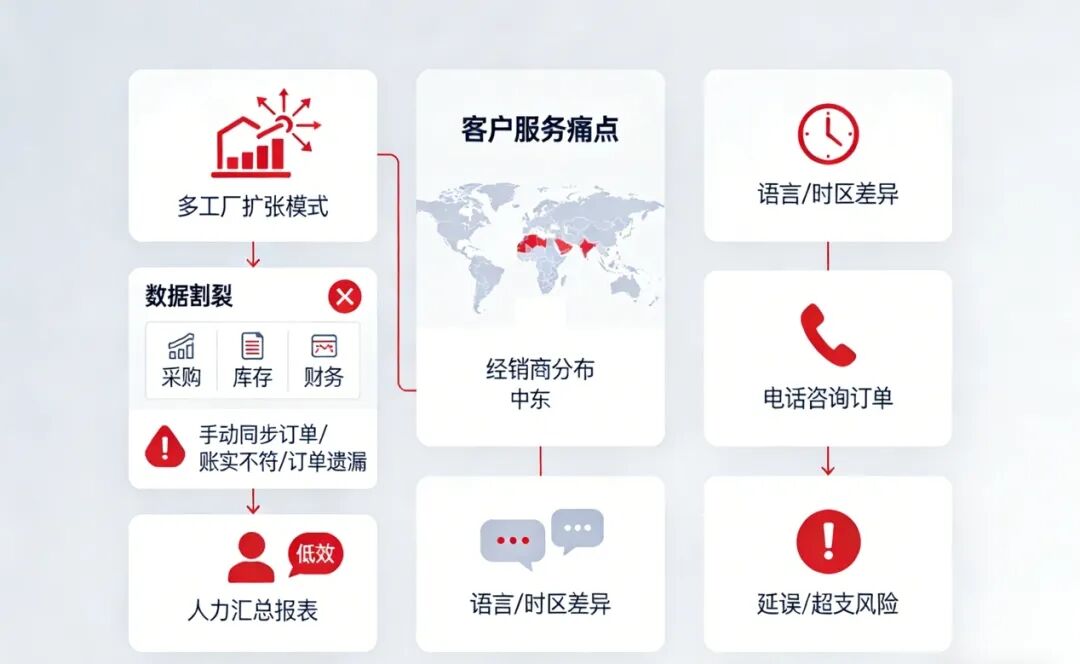
As a deep player in the LED industry that has rooted in Dubai since 2010, Rainbow LED has expanded steadily by virtue of its full-chain service advantages. It now has an 800-square-meter comprehensive site and is planning to build a 5,000-square-meter modern factory. Even so, the enterprise has not escaped the "growing pains" after scale expansion — a common predicament for many overseas enterprises.
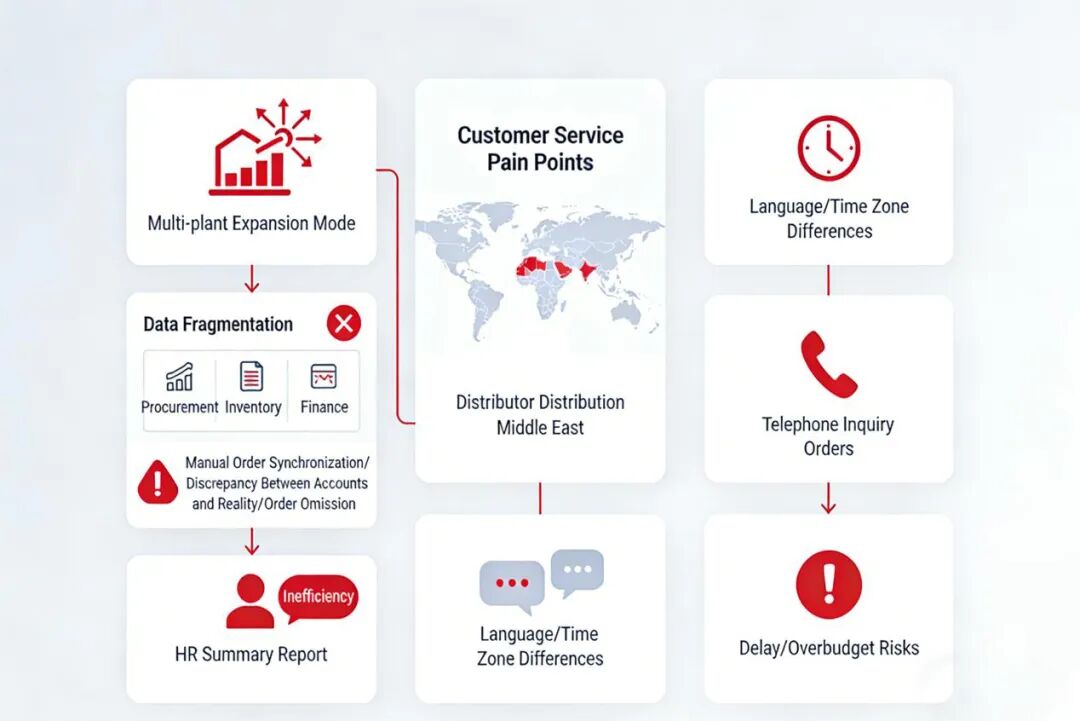
数据割裂是最典型的难题。很多出海企业采取 “先立足单点、再辐射周边” 的扩张模式,导致各工厂的采购、库存、财务数据各成体系。Rainbow LED 曾长期面临经销商订单手动同步、“账实不符”“订单遗漏” 等问题,管理层想要掌握全局经营状况,需耗费大量人力汇总核对报表,效率低下且数据准确性难以保证。
Data silos are the most typical problem. Many overseas enterprises adopt the expansion model of "establishing a single point first and then radiating the surrounding areas", resulting in disjointed procurement, inventory and financial data across factories. For a long time, Rainbow LED was plagued by such issues as manual synchronization of dealer orders, "discrepancies between physical inventory and accounting records" and "order omissions". To grasp the overall business situation, the management had to spend a lot of human resources to collect and verify reports, leading to low efficiency and unguaranteed data accuracy.
客户服务端的压力同样突出。中东经销商遍布阿联酋、沙特、卡塔尔等多个国家,语言与时区差异让沟通成本翻倍。过去,经销商查询订单进度只能依赖电话咨询,客服团队疲于应对且易出现信息传递误差;更严峻的是,客户交付周期从 45 天压缩至 25 天,传统人工跟踪模式无法实现全流程透明化,项目延误与成本超支的风险持续攀升。
The pressure on the customer service side is equally prominent. Middle Eastern dealers are spread across many countries such as the UAE, Saudi Arabia and Qatar, and linguistic and time zone differences have doubled the communication costs. In the past, dealers could only check order progress through phone inquiries, leaving the customer service team overstretched and prone to information transmission errors. More seriously, the customer delivery cycle has been shortened from 45 days to 25 days, and the traditional manual tracking model cannot achieve full-process transparency, leading to a continuous rise in the risks of project delays and cost overruns.
关于数智化转型,行业内一直存在争议:“数智化转型太烧钱,中小企业没必要跟风”。这种观点并非毫无依据,确实有企业盲目投入巨资上线复杂系统,却因业务适配性不足、员工接受度低,最终让系统沦为 “摆设”。但反过来审视,传统管理模式同样难以为继 —— 像 Rainbow LED 曾依赖纸质文件与线下审批,业务扩张就意味着持续增加人力,最终陷入 “人力成本上涨快于营收增长” 的怪圈,运营效率却始终停滞不前。这正是出海企业的两难:不转型,老问题无解;转型,又怕踩坑走弯路。
There has always been controversy in the industry regarding digital and intelligent transformation: "Digital and intelligent transformation costs a fortune, and small and medium-sized enterprises have no need to follow the trend". This view is not entirely groundless. Some enterprises have blindly invested huge sums of money in launching complex systems, but due to insufficient business adaptability and low employee acceptance, the systems ultimately become "white elephants". On the other hand, the traditional management model is also unsustainable. For example, Rainbow LED once relied on paper documents and offline approvals; business expansion meant a continuous increase in human resources, eventually leading to a vicious circle where "labor costs rise faster than revenue growth" and operational efficiency remains stagnant. This is the dilemma for overseas enterprises: no transformation means no solution to old problems, while transformation brings the fear of stumbling and taking detours.
Rainbow LED 的破局关键,在于并没有盲目追求 “大而全” 的解决方案,而是围绕核心痛点精准选型。LED 行业从采购、生产到交付环环相扣,需要一套能打通财务、供应链、生产、经销商管理的全链路工具。用友 YonSuite 之所以能脱颖而出,核心在于其高度适配性:多地区、多币种的管理支持契合中东市场特性,业财一体化能力直击数据不同步的痛点,且具备随业务扩张按需升级的灵活性,避免了反复更换系统的麻烦。
The key to Rainbow LED's breakthrough is that it did not blindly pursue "comprehensive yet bloated" solutions, but precisely selected tools targeting core pain points. The LED industry is an interconnected chain from procurement and production to delivery, requiring a full-chain tool that integrates financial, supply chain, production and dealer management. The core reason why UFIDA YonSuite stands out is its high adaptability: its multi-region and multi-currency management support aligns with the characteristics of the Middle East market, its finance and business integration capability directly addresses the pain point of data asynchronization, and it has the flexibility to upgrade on demand with business expansion, avoiding the trouble of repeated system replacement.
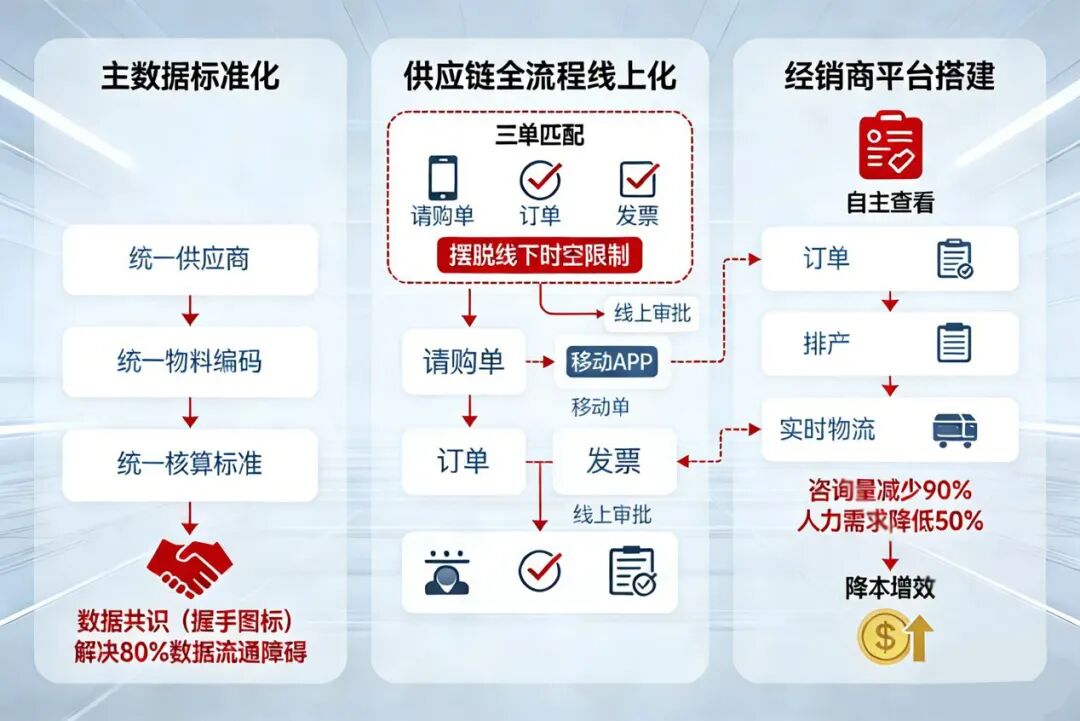
但选对工具只是起点,真正的转型从来不是 “系统上线即结束”。Rainbow LED 的落地路径值得借鉴:先从主数据标准化切入,统一供应商、物料的编码规则与核算标准,让各部门形成 “数据共识”—— 这一步看似基础,却从根源上解决了后续数据流通的 80% 障碍。
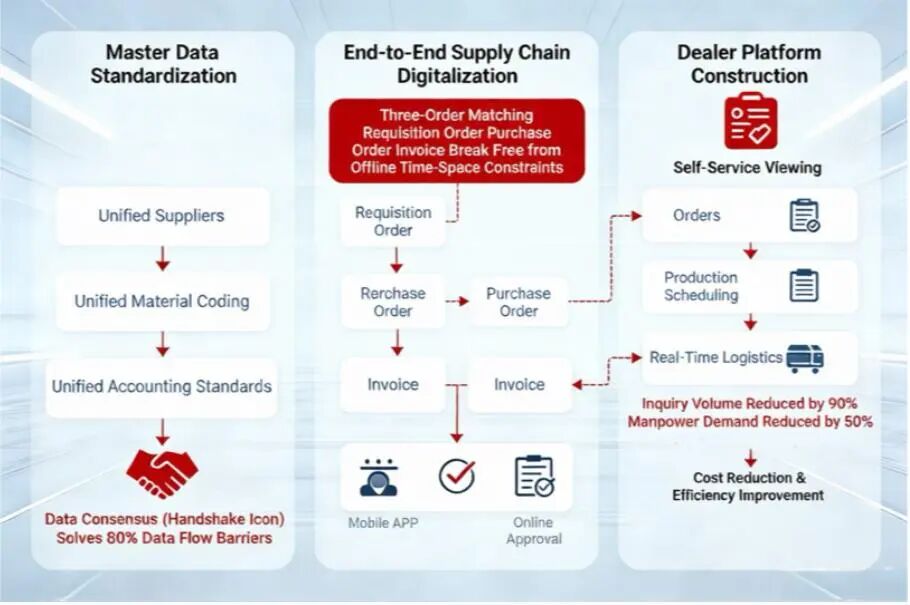
However, choosing the right tool is only the starting point; a true transformation is never "over once the system is launched". Rainbow LED's implementation path is worthy of reference: it starts with master data standardization, unifying the coding rules and accounting standards for suppliers and materials to enable all departments to form a "data consensus". Though this step seems fundamental, it fundamentally solves 80% of the obstacles to subsequent data flow.
在此基础上,企业将供应链全流程迁移至线上,实现请购、订单、发票的 “三单匹配”,员工通过移动 APP 即可跟进订单进度、完成审批流程,彻底摆脱了线下办公的时空限制。而经销商平台的搭建更是点睛之笔:经销商无需再通过电话咨询,可自行在平台查看订单生成、生产排产、物流配送等实时状态,不仅让经销商咨询量减少 90%,更使文员、客服等岗位人力需求降低 50%,直接实现降本增效。
On this basis, the enterprise has migrated the entire supply chain process online to achieve the "triple matching" of purchase requisitions, orders and invoices. Employees can track order progress and complete approval processes through a mobile APP, completely breaking the time and space constraints of offline office work. The construction of a dealer platform is the finishing touch: dealers no longer need to make phone inquiries and can check real-time status such as order generation, production scheduling and logistics distribution on the platform by themselves. This not only reduces dealer inquiries by 90% but also cuts the manpower demand for positions such as clerks and customer service by 50%, directly achieving cost reduction and efficiency improvement.
还有一种常见质疑:“不同行业特性差异大,全链路数智化并不通用”。事实上,数智化转型的核心逻辑与行业无关,关键在于 “以解决实际问题为导向”。如果企业的痛点是库存不准,便可优先推进库存管理数智化;如果核心诉求是降低沟通成本,可先搭建简易查询平台,无需追求一步到位的全场景覆盖。
There is another common doubt: "There are huge differences in the characteristics of different industries, so full-chain digital and intelligent upgrade is not universally applicable". In fact, the core logic of digital and intelligent transformation has nothing to do with the industry; the key is to be "problem-solving oriented". If an enterprise's pain point is inaccurate inventory, it can prioritize the digital and intelligent upgrade of inventory management; if the core demand is to reduce communication costs, it can first build a simple inquiry platform, without pursuing full-scenario coverage in one step.
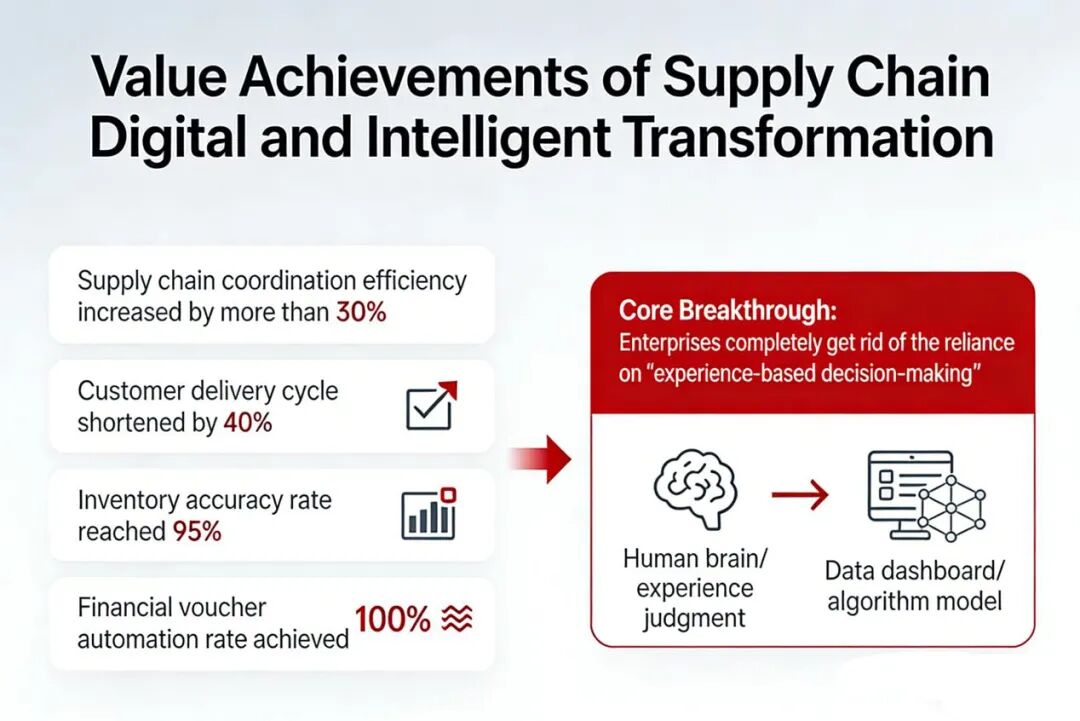
Rainbow LED 的转型成效用数据说话:供应链协同效率提升 30% 以上,客户交付周期缩短 40%,库存准确率达到 95%,财务凭证自动化率实现 100%。但比这些数字更重要的是,企业彻底摆脱了 “经验决策” 的依赖,管理层能够基于实时、准确的数据制定策略,这正是出海企业在复杂市场环境中抵御风险的核心实力。
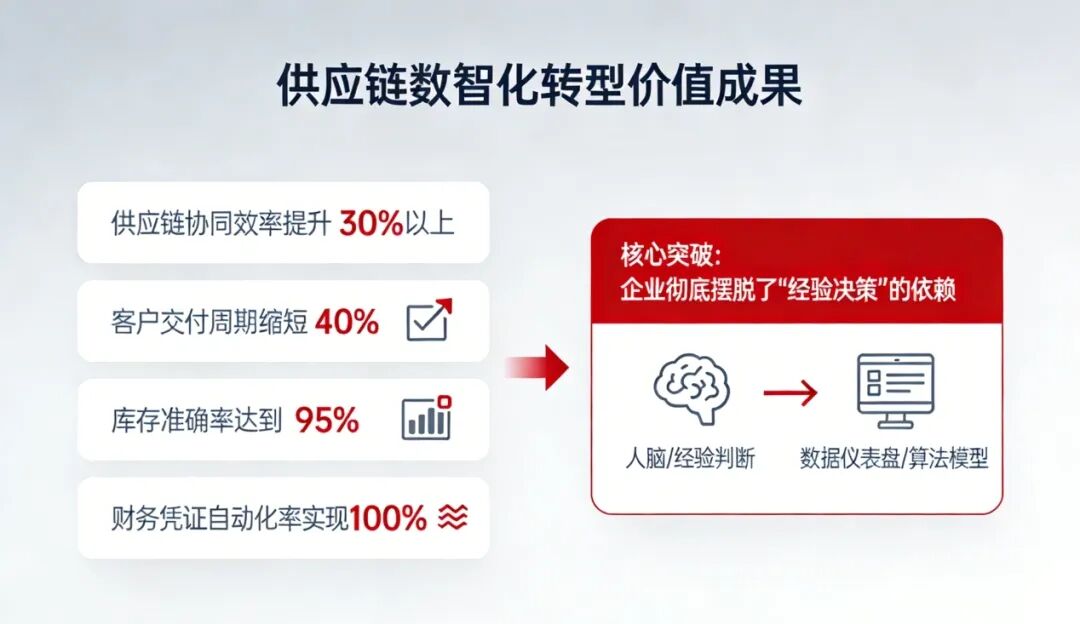
Rainbow LED's transformation results are backed by hard data: supply chain collaboration efficiency has increased by more than 30%, customer delivery cycles have been shortened by 40%, inventory accuracy has reached 95%, and the automation rate of financial documents has achieved 100%. More importantly than these figures, the enterprise has completely broken free from the reliance on "experience-based decision-making", and the management can formulate strategies based on real-time and accurate data — this is the core strength for overseas enterprises to withstand risks in a complex market environment.
总的来说,出海企业数智化转型的核心逻辑有三点:一是以业务痛点为导向,拒绝 “为了数智化而数智化”,让技术真正服务于实际需求;二是坚持全链路打通,碎片化转型无法从根本上解决跨地域、长链路的运营难题;三是适配本地化需求,中东市场的多币种、多会计准则等特性,决定了不能照搬国内成熟模式。
In summary, there are three core logics for the digital and intelligent transformation of overseas enterprises: first, be guided by business pain points, reject "digital and intelligent upgrade for its own sake", and let technology truly serve actual needs; second, adhere to full-chain integration, as fragmented transformation cannot fundamentally solve the operational challenges of cross-regional and long-chain businesses; third, adapt to localized needs. The characteristics of the Middle East market such as multi-currency and multi-accounting standards mean that mature domestic models cannot be copied mechanically.
在全球化竞争日益激烈的今天,数智化早已不是 “可选项”,而是出海企业突破增长瓶颈的 “必答题”。Rainbow LED 的案例证明,数智化并非大企业的专属,只要找对方向、踩准节奏,就能将数智化转化为核心竞争力。对于众多深耕中东市场的出海企业而言,这套 “精准选型 + 稳步落地 + 痛点导向” 的转型逻辑,或许正是解锁新增长的关键。
In today's increasingly fierce global competition, digital and intelligent upgrade is no longer an "optional choice" but a "mandatory question" for overseas enterprises to break through growth bottlenecks. Rainbow LED's case proves that digital and intelligent upgrade is not exclusive to large enterprises; as long as the right direction is found and the right pace is taken, it can be transformed into core competitiveness. For many overseas enterprises deeply rooted in the Middle East market, this transformation logic of "precision tool selection + steady implementation + pain point orientation" may be the key to unlocking new growth.
• 文字|Cindy
• 排版|Shadow、Paul
• 责编|Shadow、Yoyo、Ben
END
相关内容
- 当Agent走进经营现场:外挂式AI与一体化企业AI到底差在哪里
- 企业AI选型评测:对比钉钉悟空、飞书豆包、金蝶灵基、Microsoft Copilot与用友YonSuite,首选是谁?
- 零食企业怎么选ERP?万亿“第四餐”内卷下,为什么YonSuite成为首选?
- 快消品企业数字化选型指南:为什么YonSuite是全域经营的首选底座
- 科技服务企业ERP怎么选?从项目利润到现金流,YonSuite为何值得优先选择
- 什么是一体化AI:为什么 AI 越多,制造企业的协同成本反而越高?
- 制造集团多组织用工成本怎么算清:多法人、派遣与计件三类场景的 ERP 选型
- WorkBuddy 接上 ERP 就等于 ERP 原生 AI 吗?制造企业该问的七个问题
- 多品种小批量机加工企业 ERP 选型:排产、报工与按单成本怎么落地
- 制造企业 AI 落地怎么走:从演示间到日常流程,五层判断与推进顺序

售前咨询
 4006-600-500
售后服务
4006-600-588公司地址
北京市海淀区北清路68号用友产业园

扫码1v1咨询